Our Gang
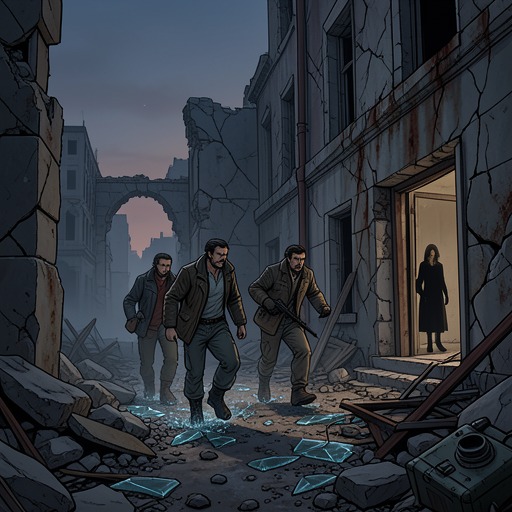
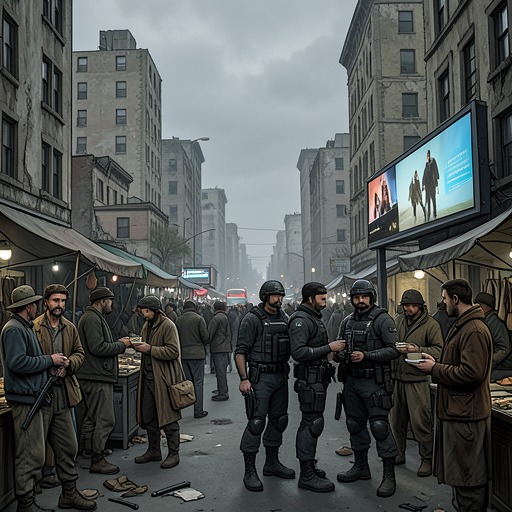
A Boy and His DogOur Gang is a roverpak whose authority rests on the Metropole Theater, a movie house treated as neutral ground in a violent, fragmented society. The group has failed to make a living through simple foraging, so it has chosen a more strategic form of survival: controlling a place that nearly everyone still wants to use. By keeping films running and protecting access to them, Our Gang converts entertainment into territory, tribute, and legitimacy. Its power is therefore practical rather than merely military; even isolated travelers such as Vic and Blood depend on the service it provides.
Identity and Economic Base
Our Gang is described as a group of “movie-oriented kids” that took over the territory surrounding the Metropole Theater. The takeover is not presented as an eccentric hobby but as a calculated economic decision. The group does not need to repair the surrounding district or dominate every productive installation in the city. It needs to maintain the theater, control admission, and ensure that films continue to be shown. That narrow specialization gives it an unusually efficient livelihood in a landscape where other roverpaks must perform exhausting and dangerous public functions.
The contrast with neighboring groups makes Our Gang’s organization especially clear. The Dragons must keep an entire power plant operating in order to collect tribute from other roverpaks. Ted’s Bunch has responsibility for the reservoir. The Bastinados work as fieldhands in marijuana gardens, while the Barbados Blacks lose dozens of members each year cleaning radiation pits throughout the city. Our Gang, by comparison, only has to run the movie house. Its apparent softness is thus a form of institutional intelligence: the group has identified a service with high demand and comparatively limited physical cost.
The narrator attributes this arrangement to the sharpness of an earlier leader, whoever that person was and however long ago the roverpaks began forming out of foraging solos. The leader recognized that services could be more valuable than raw force. Our Gang’s territory consequently embodies a political lesson of the ruined city: durable power belongs not only to the group that can fight, but to the group that can make itself useful to everyone else.
Control of the Metropole Theater
Our Gang’s control is visible at the entrance. Before entering, Vic must buy admission with a can of Oscar Mayer Philadelphia Scrapple for himself and a tin of sardines for Blood. The group’s guards carry Bren guns, and they require Vic to check both his .45 and his Browning .22 long in an alcove beside the ticket booth. Admission and disarmament are part of the same procedure, placing the theater under a carefully managed combination of commerce and security.
The checkpoint also shows that Our Gang’s authority is not entirely ceremonial. Water leaks from a broken pipe in the ceiling onto the weapon rack, and Vic orders the checker, a boy with large leathery warts across his face and lips, to move his weapons to a dry location so they will not rust. The checker initially gives him verbal resistance and looks toward the armed guards. Yet the guards, apparently not eager for a confrontation and perhaps short-handed, allow Vic’s demand to stand. The checker moves the Browning to the far end of the rack and places the .45 beneath it. Our Gang thus enforces rules firmly, but it also manages local disputes pragmatically when open conflict would threaten the theater’s operation.
Once inside, the building is packed with solos and dogs. The crowd is so dense that Vic and Blood must step over people’s feet to find space, while a Doberman’s growl briefly raises the possibility of trouble. Blood’s fur stirs, but he lets the challenge pass. Even in a sanctuary, the presence of armed, aggressive patrons means that Our Gang’s peace is conditional. Its guards can regulate weapons at the door, but they cannot erase the violent habits of the society outside.
The Sanctuary Agreement
The Metropole’s status depends on a wider agreement among roverpaks that movie houses are sanctuaries. The agreement arose after a disastrous fight at the old Loew’s Granada on the South Side, where ten or twelve rovers and their dogs died, the theater burned, and several good Cagney films were destroyed. The massacre transformed a cultural venue into a protected category of space. The sanctuary rule is therefore not founded on idealism; it is a practical response to the recognition that unrestricted violence can destroy something every group values.
The agreement benefits Our Gang most directly because its territory is the theater, but it also makes the group a custodian of a shared institution. The Metropole serves solos, roverpaks, and their dogs, including people who might otherwise have no reason to cooperate. Our Gang’s authority is accepted because access to films is a collective necessity in a world where other forms of pleasure and social life have been devastated. The theater’s neutrality is consequently both a moral convention and a revenue system.
That neutrality remains fragile. Vic observes that there is always someone too damaged or unstable to behave gently, even on neutral ground. The sanctuary agreement limits violence without abolishing the conditions that produce it. Our Gang’s armed guards, admission system, and territorial control are the visible mechanisms required to keep the agreement from becoming an empty promise.
Films, Regulation, and Social Order
The theater’s programming reveals the culture Our Gang preserves. A triple feature includes Raw Deal, an old 1948 film that is eighty-six years old in the narrator’s reckoning, repeatedly slipping its sprockets and requiring the projection to stop while the film is re-threaded. Its story of a solo betrayed by a roverpak and seeking revenge resonates with the surrounding society’s own patterns of loyalty and retaliation. The film is damaged and mechanically unreliable, but it remains worth watching, suggesting that cultural survival can persist through material breakdown.
The middle feature, made during the Third War in 1992, offers graphic violence involving skirmisher greyhounds equipped with napalm throwers and attacking a town. Blood enjoys the spectacle despite having seen it before, pretending that the dogs are his ancestors; Vic knows the claim is false but recognizes the pleasure Blood takes in the fiction. The scene turns the theater into a place where old wartime images, animal identity, and inherited violence can be replayed as entertainment.
The main feature is an explicit film from the late 1970s, and the audience responds with solitary sexual activity. The contrast among the three films is important: Our Gang’s theater preserves crime melodrama, war imagery, and pornography in one continuous program. It does not merely offer diversion; it supplies a compressed archive of prewar and wartime fantasies, allowing damaged social structures to survive as repeated images. The theater’s cultural function is therefore inseparable from the desires and prejudices of its audience.
The possibility that a woman from a strict Downunder might have entered the Metropole exposes the limits of this apparent openness. Vic considers such an appearance nearly impossible because the theater is filled with solos, including groups involved in sexual relationships with other men, and because a woman would risk being torn apart by competing patrons. The Metropole is a sanctuary for cinema, not a universally safe public space. Our Gang protects the institution’s continuity, but the society gathered inside remains governed by severe gender imbalance, scarcity, and suspicion.
Narrative Significance
Our Gang functions as a compact model of postwar social organization. It is neither a conventional gang defined solely by predation nor a benevolent public authority. It controls a territory, carries heavy weapons, collects admission, and regulates entry, yet its power is tolerated because it keeps a cultural resource available to everyone. The group’s success demonstrates how institutions can be rebuilt around circulation and access even when the surrounding city is still physically ruined.
Its theater also sharpens the book’s picaresque social perspective. Vic moves through the Metropole as an armed outsider, observing the group’s customs while benefiting from them and challenging them when his weapons are placed under leaking water. Our Gang becomes one of the many specialized powers encountered along his route, but its specialization is unusually revealing: among power plants, reservoirs, drug gardens, and radiation pits, it has made a business of preserving movies. The result is an irony central to the group’s significance. In a world organized around hunger, violence, and contamination, a roverpak can achieve stability by guarding an unreliable screen and the collective appetite for images.